Overview
Ozone is a fault-tolerant, distributed object store optimized for Big Data workloads. Its primary design goal is scalability, aiming to support billions of objects.
Ozone achieves better scalability by separating namespace management from block space management.
- The Ozone Manager (OM) daemon handles namespace-related tasks, like managing volumes, buckets, and keys.
- The Storage Container Manager (SCM) manages the physical storage layer, including the data nodes and the blocks that form the data.
Core Components
The block diagram below illustrates Ozone's main components and their interactions.
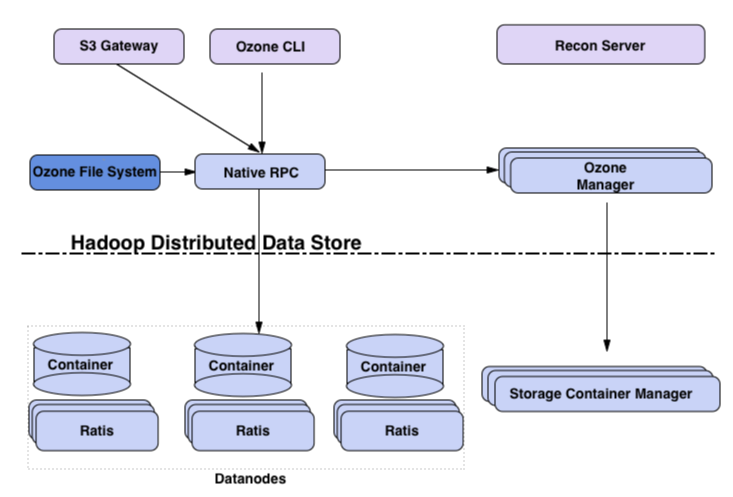
- Clients interact with Ozone to read and write data.
- The Ozone Manager (OM) acts as the namespace manager. It handles client requests for creating, deleting, or looking up keys.
- The Storage Container Manager (SCM) is the manager of the physical data layer. It manages the Datanodes and the replication of data.
- Datanodes are responsible for storing the actual data, which is organized into logical units called blocks.
- Recon is a management server for Ozone. It provides a user interface and API to monitor and manage the Ozone cluster.
Namespace and Storage
Ozone's namespace is organized into a hierarchy of volumes, buckets, and keys.
- Volumes are similar to home directories and can only be created by an administrator. They are the basis for storage accounting.
- Buckets are contained within volumes. Users can create many buckets within a volume.
- Keys hold the actual data and reside within buckets.
This separation of the logical namespace from the physical storage layer is a key aspect of Ozone's scalability.
Functional Layers
Another way to understand Ozone is by looking at its functional layers.
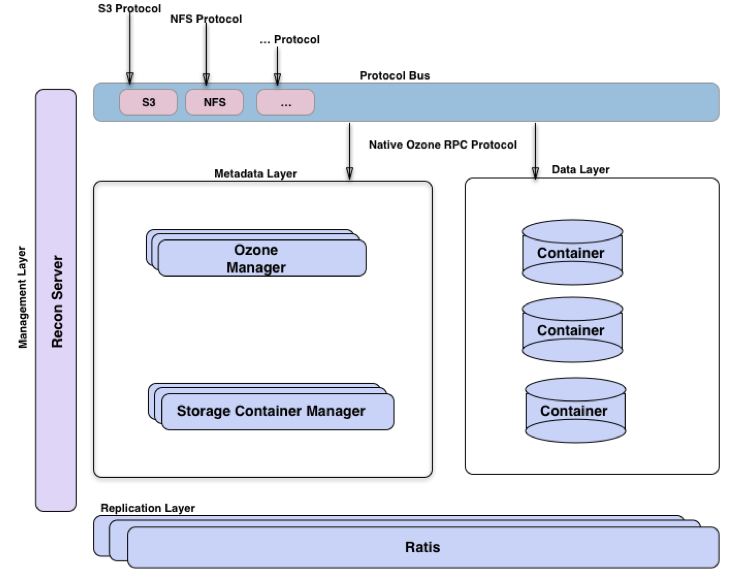
- The Metadata Management Layer is composed of the Ozone Manager and Storage Container Manager.
- The Data Storage Layer consists of the Datanodes, which are managed by SCM. Data is stored in logical blocks, which are grouped into containers for replication.
- The Replication Layer is powered by Ratis, a Java-based implementation of the Raft consensus protocol. Ratis ensures that metadata is reliably replicated across OM and SCM instances and maintains data consistency during write operations on the Datanodes.
- The Protocol Bus allows Ozone to be extended with different protocols. Currently, it supports an S3-compatible protocol. This bus allows new object store or file system protocols to be implemented on top of Ozone's native protocol.
This layered architecture, combined with a clear separation of metadata and data management, allows Ozone to scale to handle billions of objects while maintaining high performance and fault tolerance.