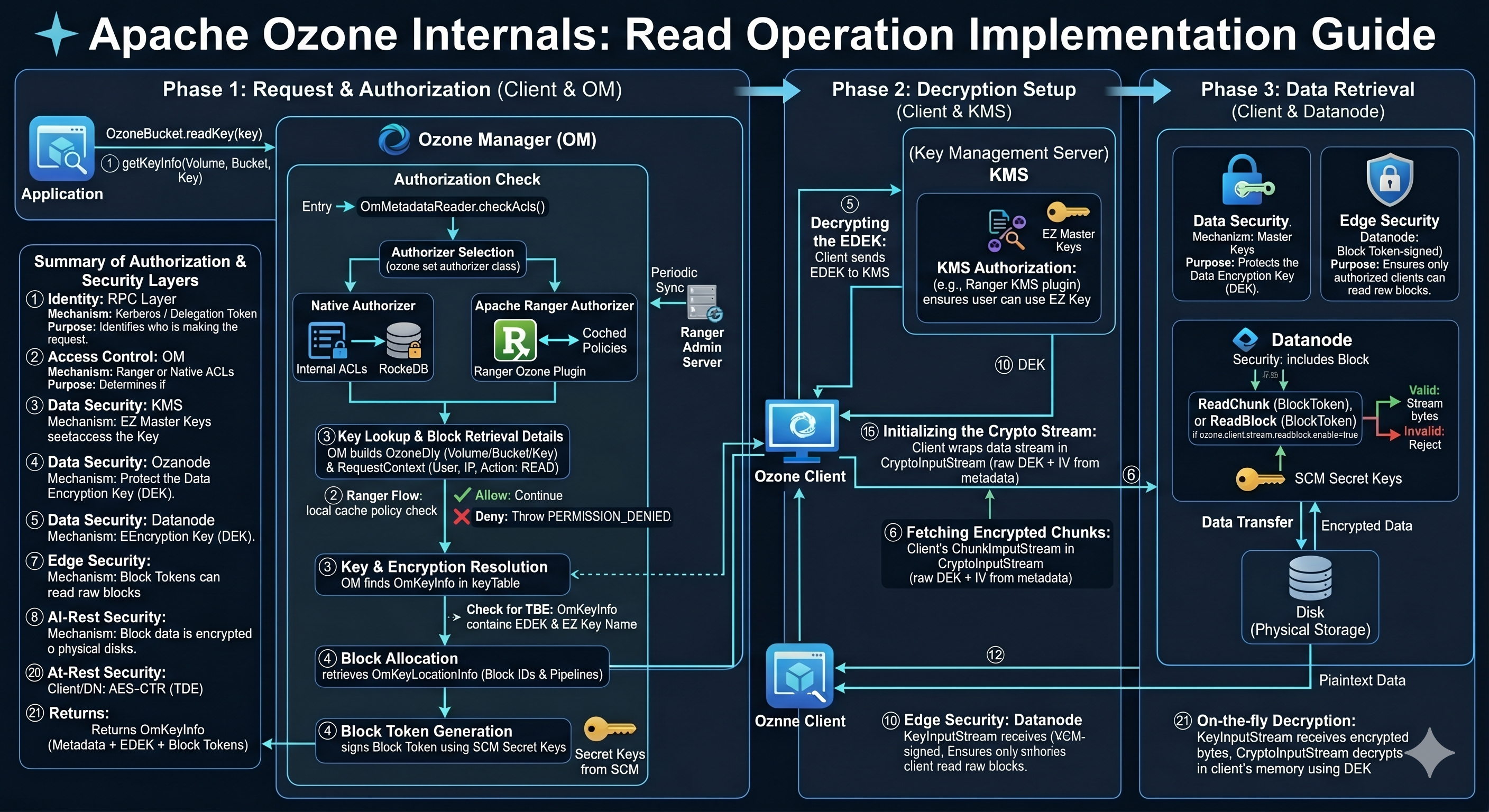
Apache Ozone Internals: Read Operation Implementation Guide
This guide provides a comprehensive trace of a read request in Apache Ozone, including metadata resolution, security (Block Tokens), Transparent Data Encryption (TDE), and Authorization (Ranger/Native ACLs).
1. Phase 1: Request & Authorization (Client & OM)
1.1 Initiating the Request
The application calls OzoneBucket.readKey(key). The client sends a getKeyInfo RPC to the Ozone Manager (OM).
1.2 OM: Authorization Check
Before returning key metadata, the OM must authorize the user.
- Entry Point:
OmMetadataReader.checkAcls()is called within thegetKeyInfoflow. - Authorizer Selection: Based on configuration (
ozone.acl.authorizer.class), OM uses either:- Native Authorizer: Uses Ozone's internal ACLs stored in RocksDB.
- Apache Ranger Authorizer: Delegates the decision to the Ranger Ozone Plugin (
RangerOzoneAuthorizer).
- Authorization Logic:
- OM builds an
OzoneObj(Volume/Bucket/Key) and aRequestContext(User, IP, Action: READ). - Ranger Flow: The plugin checks its local cache of policies (periodically synced from the Ranger Admin server). If a policy allows READ for the user/group on that resource, access is granted.
- Fallback: If Ranger is disabled or the Native authorizer is used, OM checks the object's ACL list for matching user/group permissions.
- OM builds an
1.3 OM: Key & Encryption Resolution
Once authorized:
- Key Lookup: OM finds the
OmKeyInfoin thekeyTable. - Encryption Check: If TDE is enabled, the
OmKeyInfocontains theEDEK(Encrypted Data Encryption Key) and the EZ Key Name. - Block Retrieval: OM retrieves the
OmKeyLocationInfo(Block IDs and Pipelines). Container locations are resolved using OM's container location cache; pipeline and placement metadata may be refreshed from SCM when needed. For locality-aware reads, OM can sort Datanodes within each pipeline by network distance using the network topology cached in OM (synchronized from SCM). - Block Token Generation: OM generates a signed Block Token for each block using secret keys managed by the SCM.
OM returns OmKeyInfo (Metadata + EDEK + Block Tokens) to the client.
2. Phase 2: Decryption Setup (Client & KMS)
2.1 Decrypting the EDEK
If the key is encrypted:
- KMS Request: The client sends the
EDEKto the KMS (Key Management Server). - KMS Authorization: The KMS also performs an authorization check (often via Ranger KMS plugin) to ensure the user can use the EZ Key for decryption.
DEKRetrieval: KMS returns the rawDEK(Data Encryption Key) to the client.
2.2 Initializing the Crypto Stream
The client wraps the data stream in a CryptoInputStream initialized with the raw DEK and the IV from the metadata.
3. Phase 3: Data Retrieval (Client & Datanode)
3.1 Fetching Encrypted Chunks
If ozone.client.stream.readblock.enable is true (default is false), the client may issue an optional ReadBlock request instead. Otherwise, the client issues ReadChunk.
- Security: The request includes the Block Token.
- Datanode Validation: The Datanode verifies the token's signature using the Secret Keys it fetched from the SCM. This is the final "at-the-edge" authorization check.
- Data Transfer: The Datanode reads the encrypted data from disk and streams it back.
3.2 On-the-fly Decryption
KeyInputStreamreceives encrypted bytes from the network.CryptoInputStreamdecrypts the bytes in the client's memory.- The application receives the original plaintext data.
Summary of Authorization & Security Layers
| Layer | Component | Mechanism | Purpose |
|---|---|---|---|
| Identity | RPC Layer | Kerberos / Delegation Token | Identifies who is making the request. |
| Access Control | OM | Ranger or Native ACLs | Determines if the user can see/access the Key. |
| Data Security | KMS | EZ Master Keys | Protects the Data Encryption Key (DEK). |
| Edge Security | Datanode | Block Tokens (SCM-signed) | Ensures only authorized clients can read raw blocks. |
| At-Rest Security | Client/DN | AES-CTR (TDE) | Ensures data is encrypted on physical disks. |
Read Path Logic Flow
 1 Application -> [OzoneClient]
 2                   |
 3         (1) getKeyInfo(Volume, Bucket, Key)
 4                   |
 5         [Ozone Manager] -> (2) [Ranger/Native Authorizer] (Access READ?)
 6                   |                 |-- Yes: Continue
 7                   |                 |-- No:  Throw PERMISSION_DENIED
 8                   |
 9         (3) Fetch OmKeyInfo (Metadata + `EDEK` + Block IDs)
10         (4) Sign Block Tokens using SCM Secret Keys
11                   |
12         <-- Returns OmKeyInfo --
13                   |
14         (5) [Client] -> KMS: decrypt(`EDEK`) -> returns `DEK`
15         (6) [Client] -> Datanode: ReadChunk (BlockToken), or ReadBlock (BlockToken) if ozone.client.stream.readblock.enable=true
16                   |
17         [Datanode] -> (7) Verify Block Token Signature
18                   |                 |-- Valid: Stream bytes
19                   |                 |-- Invalid: Reject
20                   |
21         (8) [Client] decrypts bytes using `DEK` -> returns Plaintext
System diagram