Recon UI — Volumes Page
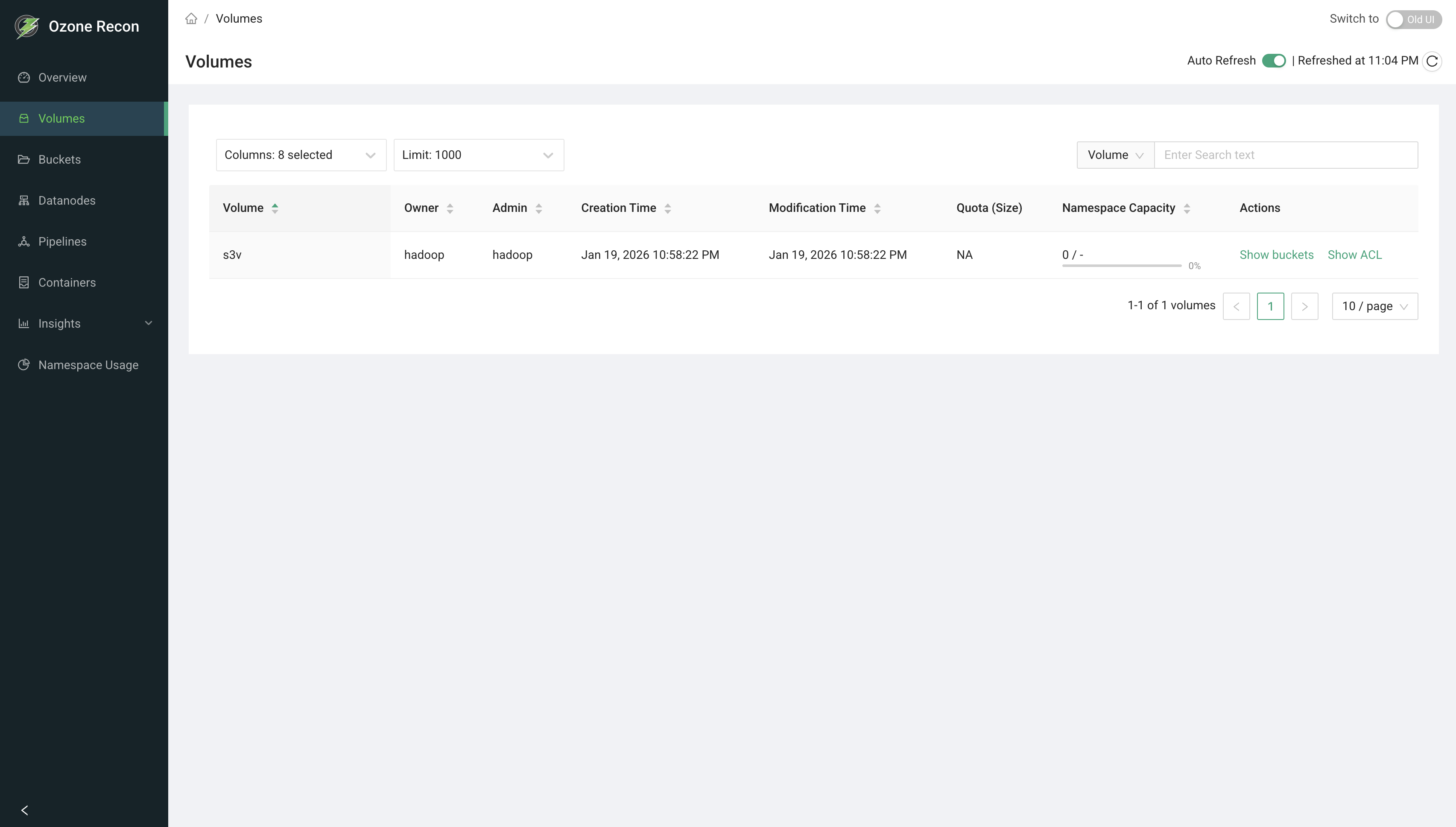
1. Page Overview
The Volumes page lists the volumes in your Ozone cluster and their key properties: owner, administrator, creation and modification times, quota, and namespace usage. From here you can inspect a volume's access control list (ACL) and jump to the buckets inside a volume.
It is a read-only listing used to browse and search volumes and to review their ownership and quota settings.
2. When to Use This Page
- To browse all volumes in the cluster and see who owns them.
- To find a specific volume by name, owner, or admin.
- To review a volume's quota and how much of its namespace is in use.
- To inspect the ACLs (permissions) configured on a volume.
- As a jumping-off point to the buckets contained in a volume.
3. How to Access the Page
Open the Volumes entry in the left navigation menu, or go to the /Volumes
route directly. You can also reach a filtered view from the Volumes count
card on the Overview page.
4. Information Displayed
The page header shows the title and an Auto Reload panel (see Available Actions). The main area is a single table of volumes.
Table columns
- Volume — the volume name. Sortable; sorted ascending by default.
- Owner — the user that owns the volume. Sortable.
- Admin — the administrator of the volume. Sortable.
- Creation Time — when the volume was created. Shows
NAif not available. - Modification Time — when the volume was last modified. Shows
NAif not available. - Quota (Size) — the storage quota set on the volume. Shows
NAwhen no quota is set. - Namespace Capacity — a bar showing used namespace against the namespace
quota (number of objects allowed). Hovering shows the used and remaining
values. A quota of
-1(unset) is shown as-. - Actions — per-row links:
- Show buckets — opens the Buckets page filtered to that volume.
- Show ACL — opens a side panel listing the volume's ACL entries.
ACL side panel
Selecting Show ACL opens a drawer showing the access-control entries configured on the volume (who has access and what permissions they hold).
5. Available Actions
- Columns selector — choose which columns are visible. The Volume column is always shown; you can remove others by unchecking them or closing their tag.
- Limit selector — controls how many volumes are fetched from the server. Options are 1000, 5000, 10000, and 20000 (default 1000).
- Search — filter the loaded rows by Volume, Owner, or Admin. Pick the field to search, then type; matching is a simple contains match and is applied to the rows already loaded. Search is disabled when the table is empty.
- Sort — click a sortable column header (Volume, Owner, Admin, Creation Time, Modification Time, Namespace Capacity).
- Pagination — page through results; the page size is adjustable and the
footer shows the range and total (for example,
1-10 of 240 volumes). - Auto Reload panel — an Auto Refresh toggle (refreshes every 60 seconds and remembers your choice for the session) and a manual reload button that shows the last refreshed time.
- Row links — Show buckets and Show ACL as described above.
6. How to Interpret the Information
- Quota (Size) = NA: no size quota is set on the volume, so it is not limited by a volume-level size quota.
- Namespace Capacity bar: a nearly full bar means the volume is close to its
namespace quota (the number of objects it may contain);
-means no namespace quota is set. - Creation / Modification Time = NA: a timestamp was not available for that volume.
- Search vs. Limit: search filters only the rows already loaded. If you expect a volume that is not showing, increase the Limit so it is included in what is fetched, then search.
7. Common Use Cases
- Find a tenant's volumes. Set Search to Owner, type the user name, and review the matching volumes and their quotas.
- Check quota pressure. Sort by Namespace Capacity to see which volumes are closest to their namespace quota, then plan quota increases.
- Audit access. Use Show ACL on a volume to confirm which users and groups have permissions, and Show buckets to continue the review at the bucket level.
8. Important Notes and Limitations
- Data freshness. The volume list comes from Recon's own copy of the Ozone Manager (OM) database, which is updated by a periodic sync. Very recent changes on OM may not appear until the next sync. Auto Refresh only re-queries Recon; it does not force a re-sync from OM.
- Limit caps the result set. Only up to the selected limit of volumes is fetched. On very large clusters, raise the limit to see more, keeping in mind larger limits take longer to load.
- Search and sorting apply to loaded rows only, not to volumes beyond the selected limit.
- On an error, the page reports a data-fetch error and the table stays empty.
9. Related Pages
- Buckets — the buckets inside a volume (reachable via Show buckets).
- Overview — cluster-wide totals, including the volume count.
- Namespace Usage — disk usage broken down across the namespace.